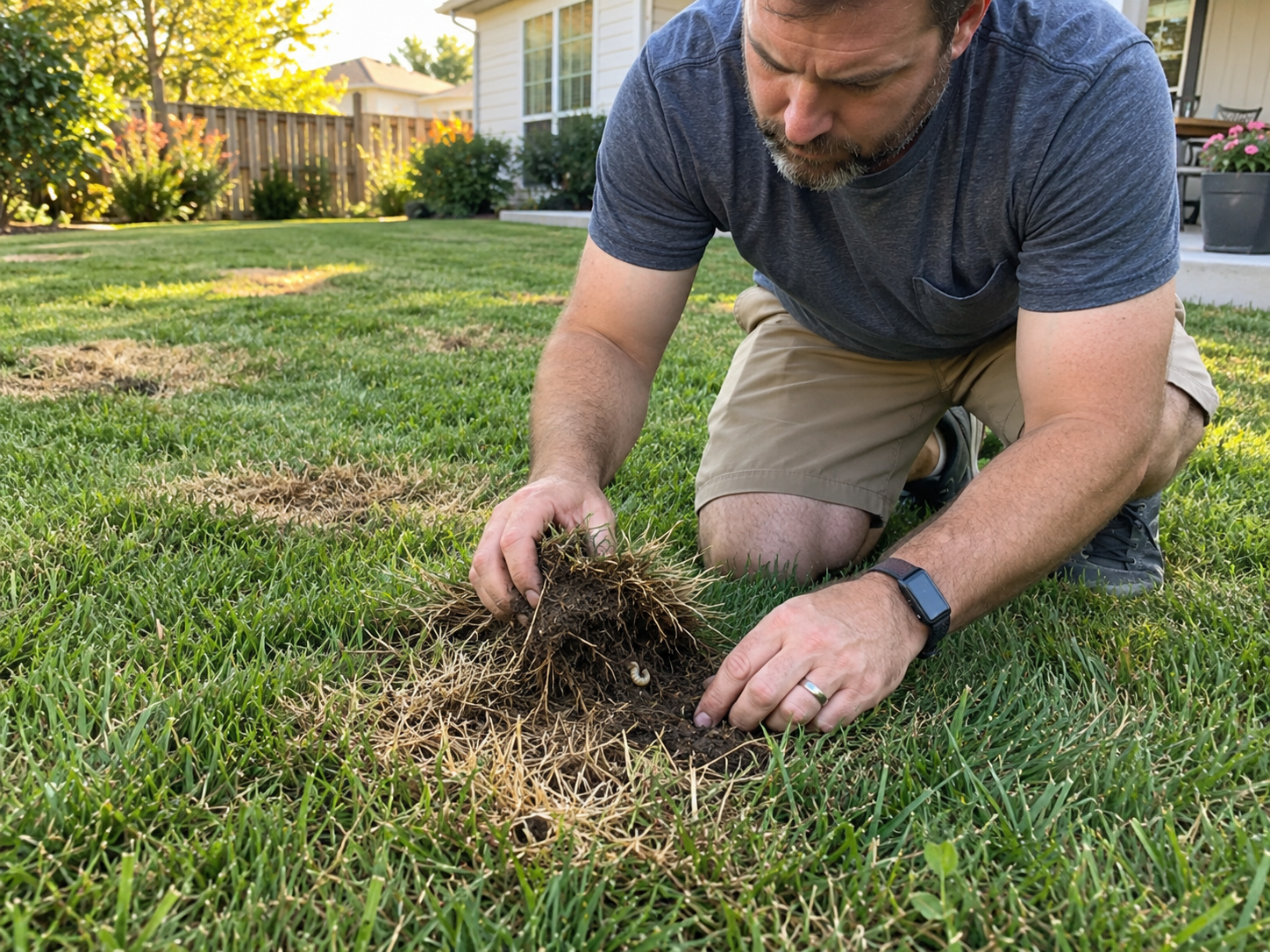
Not sure what type of grass is growing in your backyard? You’re certainly not alone. Plenty of homeowners inherit an established lawn when they move into a property, while others simply know they have grass but have never needed to know exactly what variety it is.
Identifying your grass is worth doing because different lawn types need different care. Mowing height, watering, fertilising, renovation and even which lawn-care products you can safely use can depend on the grass you have.
Around Melbourne and Victoria, some of the most common lawn types you’ll come across are Buffalo, Kikuyu, Couch and Tall Fescue. At first glance they can look similar, particularly when freshly mown, but there are some useful clues that make identification much easier.
Here’s what to look for.
The easiest way to identify lawn grass is to look at several features together rather than relying on colour alone.
Start with a healthy section of lawn and look closely at:
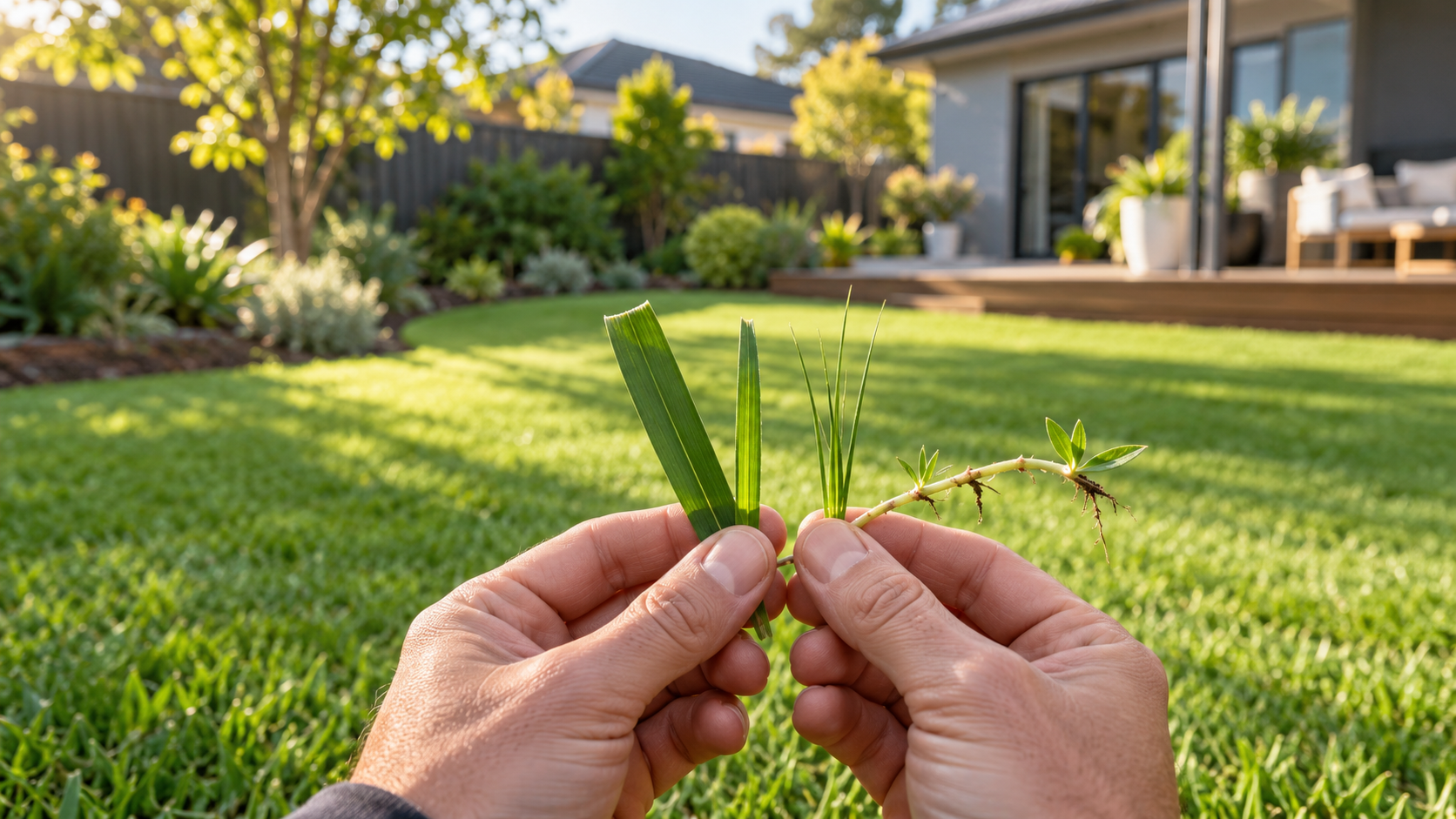
Try not to identify your lawn from one freshly mown leaf. Pull back the canopy and find a complete piece with leaves, stems and runners attached. Those runners are often the giveaway.
Also keep in mind that colour can be deceptive. Watering, fertiliser, shade, soil conditions and the time of year can all change how green a lawn looks.
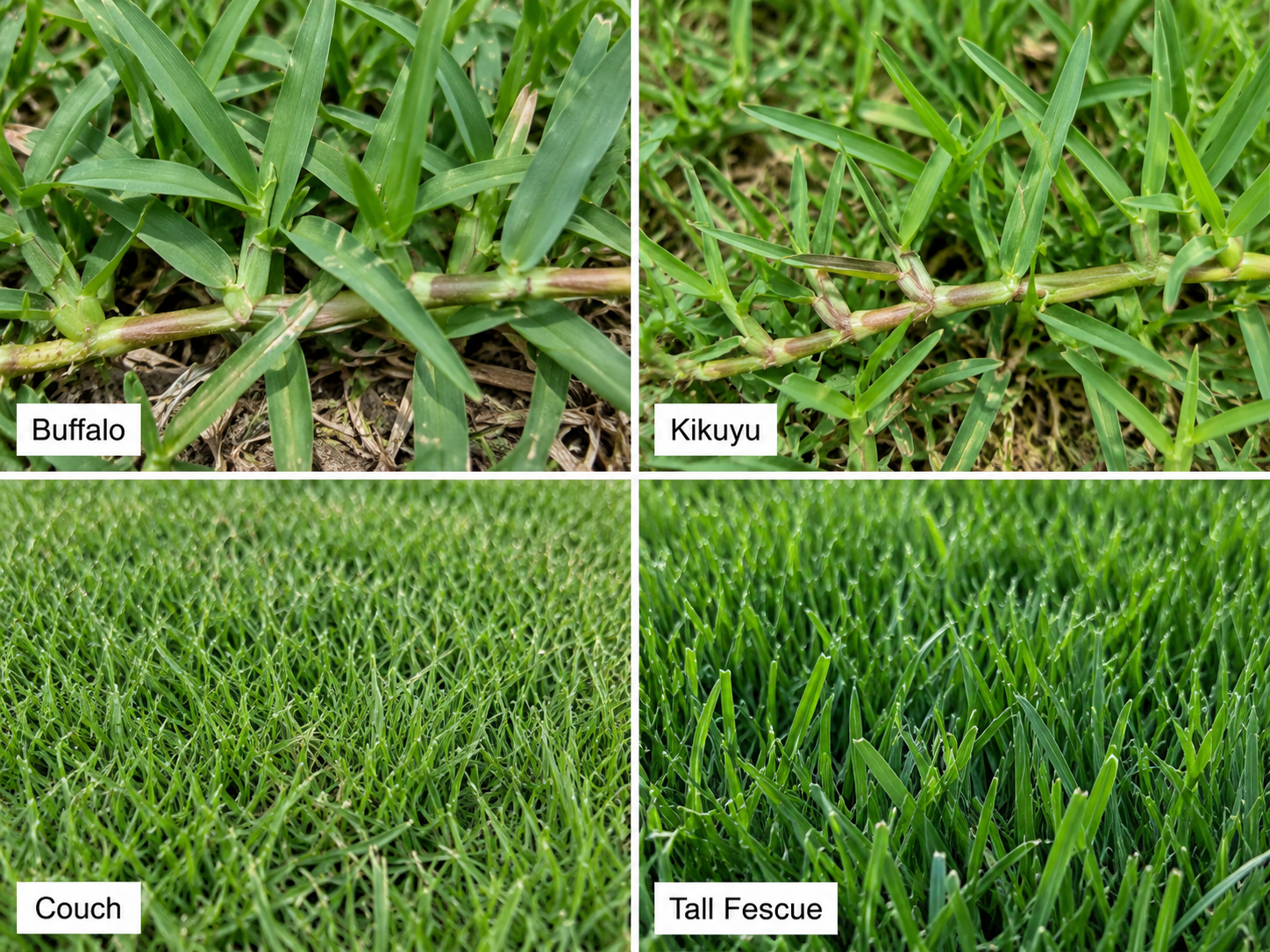
Buffalo grass is usually recognised by its broad, soft leaves and thick above-ground runners.
If you’re wondering what Buffalo grass looks like, start by looking underneath the leaves. Buffalo produces noticeable stolons, or runners, that travel across the soil surface and put down roots as they grow.
The leaf itself is considerably broader than Couch and generally broader and less pointed-looking than Kikuyu. Modern soft-leaf Buffalo varieties feel relatively smooth underfoot rather than coarse or scratchy.
Buffalo also tends to form a dense canopy, so established lawns can hide the runners until you separate the leaves with your fingers.
In Melbourne, another clue can appear in winter. Buffalo is a warm-season grass, so growth slows significantly when soil temperatures fall and some lawns lose colour during colder weather.
Best identification clue: Find a thick surface runner with broad leaves emerging from it. If there are no underground runners and the leaf is broad and soft, Buffalo is a strong possibility.
HG Turf Group’s Prestige® Buffalo is an example of this type of lawn.
Kikuyu is a vigorous, spreading grass with medium to broad leaves and strong runners.
When homeowners ask how to identify Kikuyu grass, its growth habit is often more useful than its colour. Kikuyu grows quickly when conditions are warm and can send runners across lawn edges, garden beds and paths if it is not regularly maintained.
The leaf is generally narrower than Buffalo but noticeably broader than fine Couch grass. It commonly has a bright, fresh green appearance during active summer growth.
Pull apart the lawn and you should find a network of runners. Kikuyu can spread both above and below the soil surface, which is one reason it repairs worn areas quickly and can be difficult to contain once established.
It also responds strongly to Melbourne’s warmer spring and summer conditions before slowing and potentially losing colour through winter.
Best identification clue: Look for an aggressively spreading lawn with medium-width leaves and runners that seem determined to explore beyond the lawn edge.
Couch grass has a much finer leaf than Buffalo or Kikuyu and forms a low, dense lawn with slender runners.
If you’re trying to work out what Couch grass looks like, leaf width is the first place to start. Couch has narrow, fine blades that give the lawn a tightly packed, refined appearance when it is well maintained.
Couch spreads through both above-ground stolons and underground rhizomes. The runners are much finer than the thick stolons you would expect to see in Buffalo.
It also performs particularly well when maintained at a lower mowing height, which is why Couch is frequently associated with manicured lawns and sports surfaces.
Like Buffalo and Kikuyu, Couch is a warm-season grass. In Melbourne it may slow considerably and lose colour during the colder months before becoming active again as temperatures rise.
Best identification clue: If the lawn has very fine leaves, a dense surface and thin creeping runners, there is a good chance you are looking at Couch.
HG Turf Group’s Santa Ana Sports Couch is a fine-leaf Couch variety commonly used across Victorian lawns and sporting surfaces.
Tall Fescue is easiest to distinguish by its upright growth, broader leaves and lack of the obvious creeping surface runners seen in warm-season grasses.
Rather than forming a mat of visible runners, Tall Fescue has a more upright, bunching growth habit. The leaves are generally longer, dark green and clearly ribbed when examined closely.
It also tends to be maintained at a higher mowing height than Couch, Kikuyu or Buffalo, giving established Tall Fescue lawns a softer, deeper appearance.
Seasonal behaviour provides another important clue. Tall Fescue is a cool-season grass, so it can retain strong green colour through a Victorian winter when neighbouring warm-season lawns have slowed or become pale.
The trade-off comes during summer. Tall Fescue generally needs more attention to watering during Melbourne’s hot, dry periods than warm-season varieties such as Couch or Kikuyu.
Best identification clue: If your lawn grows upright rather than racing sideways across the ground and stays actively green through winter, Tall Fescue should be high on your list.

One of the biggest mistakes when identifying grass is using colour alone. A pale Buffalo lawn in winter and a healthy Buffalo lawn in summer can look remarkably different. Fertiliser, water and shade can change colour too.
Another common mix-up is Buffalo and Kikuyu. Both can have relatively broad leaves and visible runners. Look more closely at the runners and growth habit. Buffalo generally has thicker surface stolons, while Kikuyu has a more vigorous spreading habit and can run both above and below the soil.
Couch can also be mistaken for other fine grasses. Don’t rely on a handful of narrow leaves. Check whether the lawn forms a dense creeping network of fine runners.
Season matters too. Warm-season grasses such as Buffalo, Kikuyu and Couch can be harder to compare during a Melbourne winter because they are growing slowly and may have lost colour.
And sometimes there isn’t one answer.
Yes. Mixed lawns are common.
An older lawn may contain two turf varieties, invading grasses or seasonal grasses that have established over time. Some lawns are also oversown with Ryegrass for winter colour.
If one part of the lawn looks noticeably different, take samples from several areas rather than assuming the entire yard is the same variety.
Correct identification becomes especially important before applying herbicides or carrying out major renovation work. A treatment that suits one grass type may damage another.
Once you know your lawn type, you can start looking after it according to how that grass actually grows.
For Buffalo, that generally means maintaining a slightly higher mowing height, protecting its runners and choosing Buffalo-safe lawn treatments.
Kikuyu rewards regular mowing and edging during its strongest growing months, when its vigorous runners can move quickly.
Couch performs best with good sunlight and more regular mowing when actively growing, particularly if you want a short, tightly maintained lawn.
Tall Fescue prefers a higher cut and requires a different seasonal approach because it remains active through cooler weather and needs more attention during hot Victorian summers.
For more detailed advice, explore our Buffalo Lawn Care Calendar for Victoria, Santa Ana Couch Lawn Care Calendar for Victoria, and our guide to Why Tall Fescue Grass Is a Hidden Gem for Victorian Homes.
If you’re comparing varieties rather than identifying an existing lawn, our guides to Lawn Types for Victoria and Cool Season or Warm Season Grass can also help narrow down the best option for your property.
Sometimes the quickest way to confirm a lawn variety is to have someone who works with turf every day take a look.
If you’re still unsure what grass you have, or you’ve identified your lawn and decided it is time for a change, explore HG Turf Group’s premium Melbourne-grown turf varieties.
From Buffalo and Kikuyu to Couch and Tall Fescue, we can help you choose a lawn that suits your home, sunlight, lifestyle and the Victorian climate.
Browse our turf varieties or get a fast online quote for your property today.